
First establish whether dimensions describe the overall panel or its effective installed coverage. Then check whether they are catalogue references or confirmed order specifications for the selected model and colour. Area, quantity and price comparisons need those distinctions.
PU and MCM formats can differ, as can models within either range. Do not transfer one panel's coverage to another, or assume separately listed colours, sizes and thicknesses can be freely combined into an available product.
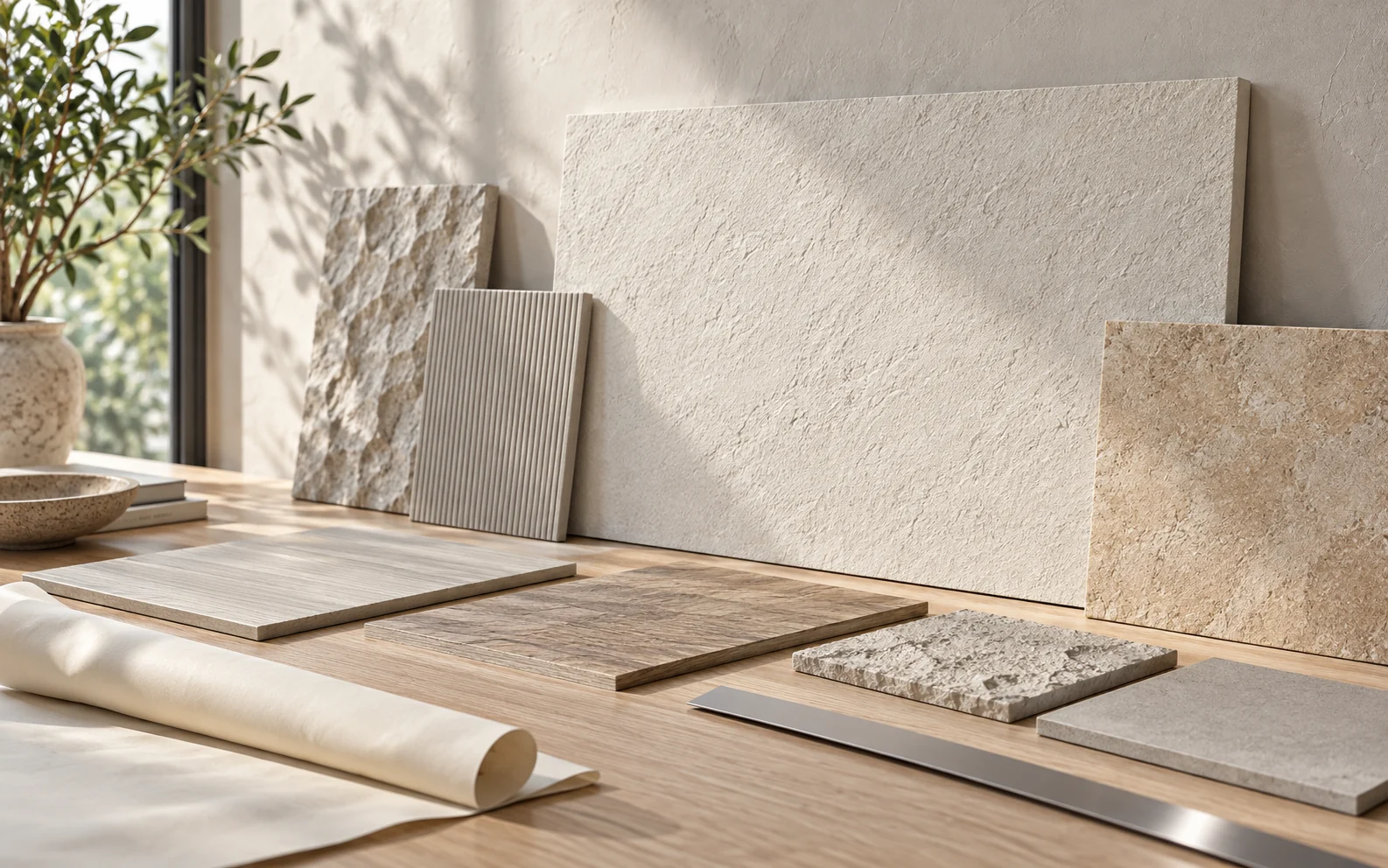
Cover: Illustrative concept: full panels, samples and layout planning; use model information for actual dimensions
1. Overall dimensions and effective coverage answer different questions
Overall length and width help establish panel size, handling and layout. If a product has overlapping or joining edges, part of its overall area may not provide independent coverage. Without joint and coverage information, overall length multiplied by width should not be used to confirm installation quantities.
Effective coverage dimensions or area describe the wall covered under the relevant joining arrangement. Ask for effective length and width or area per panel, and the joint and layout conditions behind it. Use information for the selected format rather than measuring photographs.
Thickness also needs a clear definition. For pronounced PU relief, distinguish base thickness from maximum projection. For textured sheets, establish whether the stated figure includes relief or other construction details. Junctions with adjacent finishes, openings and sockets may require measurements at different positions.
2. Read the listed MCM specifications in context
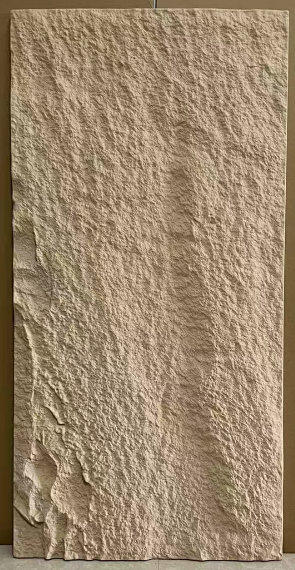
The table retains catalogue reference information for three listed YEYU models. Dimensions are in mm. These are selection references, not effective coverage figures or a guarantee that every combination is available for every colour.
| Product | Catalogue reference sizes (mm) | Catalogue reference thickness (mm) |
|---|---|---|
| Solid-colour travertine-look flexible stone G0001 | 1200 × 600 / 1200 × 2400 / 2400 × 600 | 2.5–3 |
| Fine rammed-earth-texture flexible stone G0042 | 1200 × 600 / 2400 × 600 / 1200 × 2400 | 3–4 |
| Fine linear-texture flexible stone G0071 | 1200 × 2400 / 2400 × 600 / 3000 × 600 / 1200 × 300 | 3–5 |
See the corresponding pages for G0001, G0042 and G0071. Once you choose a model, include target dimensions, thickness and colour in the same inquiry to confirm the actual options and information.
For lines, wood grain or horizontal layers, also ask how the dimensions relate to texture direction. Similar dimensions do not mean rotating a panel produces the same appearance. The order of dimension figures alone is not enough to establish grain direction.
3. Use consistent units before estimating quantity
Record each wall's width and height, openings, corners and other details, then establish the intended layout. Use consistent area units. If the wall is measured in m², convert effective panel coverage to m² too, instead of combining mm dimensions with a different area unit.
A basic panel count is the net wall area divided by effective coverage per panel, rounded up. That is a starting quantity. Review the layout, cuts, opening surrounds, corners and spare material before confirming the order. Large openings cannot always be handled simply by subtracting area, because cuts may still be required around them.
Avoid a fixed waste percentage for every project without a layout basis. Several narrow walls, directional textures and special corners can require different quantities even when the total area is the same. A wall sketch is often more useful than a single area total.
4. Format affects joints, transport and site arrangements
A larger format may change joint positions and texture rhythm. It also needs to be assessed against access routes, handling space and installation arrangements. Fewer pieces alone do not establish less work; joint treatment and edge finishing also influence the result.
For international orders, distinguish effective coverage, pack quantity, packing volume and weight. These are separate measures. If prices are expressed per panel, per area or on another basis, confirm the pricing unit and scope before comparing materials and delivery for the same wall.
Obtain this information for the actual PU or MCM format. A size table helps narrow the choice, but does not establish fixing methods, substrate requirements, outdoor suitability or other performance.
5. Make a dimension inquiry specific enough to confirm
A useful inquiry includes the product code and colour, preferred specification, dimensions or sketches for each wall, estimated quantity, destination and expected timing. For curves, add the profile, radius and panel direction. Include any existing installation or project requirements.
Then confirm the actual dimensions, thickness, effective coverage per panel and quantity unit used in the quotation. If information remains a reference range, clarify the intended option instead of treating one figure within that range as an agreed order specification.
Start with the PU catalogue or MCM catalogue, then send YEYU your shortlisted models and wall information. This moves the preferred texture towards a clearly identified product and quantity.
Contact YEYU. Email: sales@yeyupu.com; WhatsApp: +853 6206 6872.