Some PU products can bend; others are designed with a fixed shape. To decide whether a PU wall panel suits a curved surface, check the actual finished product. PU stone describes a material and an intended appearance. The broad market term “soft stone” is also used for different products. Neither name alone tells you whether a panel can bend.
Choosing a material for a curved wall, column or rounded corner involves more than asking whether it can be bent by hand. The useful question is whether this panel can follow the required curve under its specified conditions while maintaining the surface, joints and fixing arrangement required by the design.
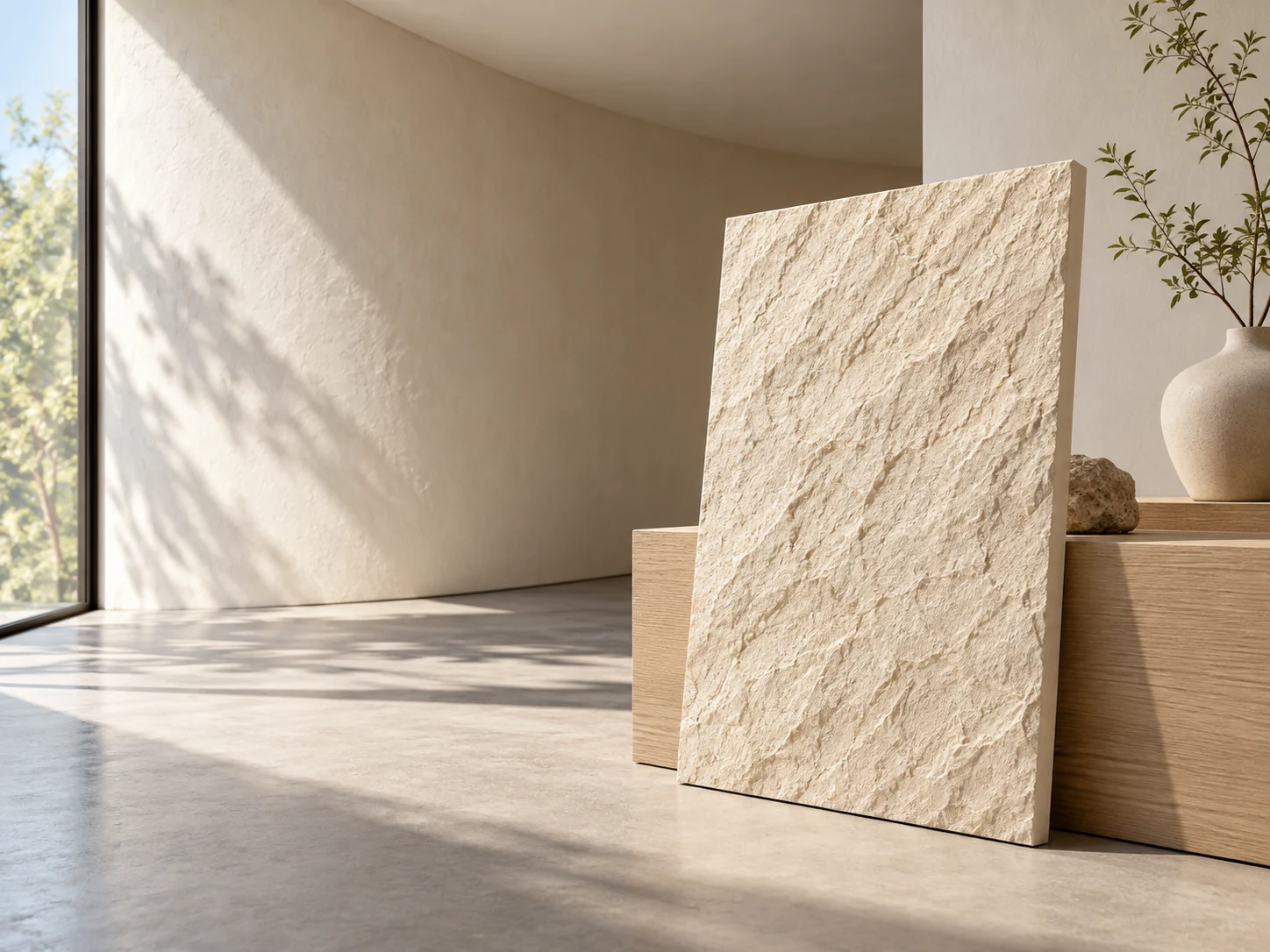
Cover: Illustrative concept: a curved plaster wall and a flat textured sample; confirm bending conditions for the specific panel model
1. Why can PU be rigid or flexible?
Polyurethane is a family of materials. Changes in formulation, the material structure formed during reaction and processing can produce different hardnesses, densities and forms. PU can therefore be used for flexible foams, rigid foams and other moulded products.
The raw-material industry recognises these distinctions. ISOPA's material introduction lists rigid and flexible foams, as well as rigid and flexible integral skin foams. This explains the different forms of polyurethane. It does not mean those forms can be used interchangeably as the same wall panel.
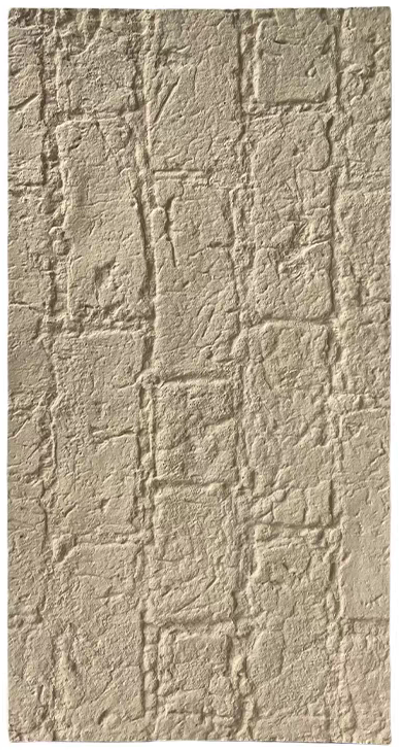
For common three-dimensional stone-effect panel formats, retaining the rock profile and a fixed shape may be a design objective. Other products may use different material systems or constructions to accommodate particular curves. Understanding what each rigid or flexible product is designed to do is more useful than comparing only which one bends more easily.
2. Softness, elasticity and bendability describe different things
These words often appear together in marketing, but they describe different behaviour.
Softness usually describes how readily a material deforms under a local force or how it feels. Pressing a surface by hand does not tell you how far the full panel can bend along its length.
Elasticity concerns recovery after deformation under a force. A product that springs back after bending still may require an appropriate construction or fixing arrangement to remain on a curve over time.
Bendability describes a finished product's ability to accommodate bending under particular conditions. Those conditions also need to identify the permitted direction, curvature, temperature and handling method. Bending within one range does not mean a panel can be folded backwards or taken around a right angle without a rounded transition.
Separating these terms helps clarify what a product description actually promises. A flexible material, a full panel that can bend, and a finished installation suited to a particular curve are three matters to confirm individually.
3. How does the finished construction affect bending?
When a panel bends, its inner and outer sides undergo different deformation. With other conditions equal, thickness and structure affect how readily it bends. Across different formulations and panel shapes, however, thinner cannot simply be taken to mean more flexible.
Relief texture also matters. A panel with raised areas and grooves may have different cross-sections in different places. Its surface and edges may behave differently depending on the bending direction. The base material, surface treatment and any backing actually present need to accommodate deformation together as one finished product.
The ability of the core material to deform does not, by itself, show that the coloured surface, joining edges and other components can meet the same conditions. Specify the curved-surface requirement for the complete product, rather than for a material category alone.
If the information gives a minimum bending radius, it describes a geometric limit for permitted bending. A smaller radius means a tighter curve. Check which model, bending direction and test or installation conditions the value applies to. A figure from a different panel format cannot be transferred to the product you intend to use.
4. What should you check in a panel-bending video?
A video can show one deformation, but conditions outside the frame often determine whether it is relevant to your project. Check:
- Whether it shows the actual finished product or an unfinished material sample;
- Whether the sample's model, dimensions and thickness match the full panel;
- Whether it was heated, grooved or otherwise treated before bending;
- Whether it shows bending in progress, a brief hold, or verification relevant to actual use;
- The condition of the surface, edges and joints after recovery or while held on the curve.
With this information, the demonstration becomes more useful for comparison. Heating or grooving changes the original conditions. A demonstration using a treated sample does not show that the finished product can be cold-bent directly, and should not be copied without appropriate product instructions.
For a product with no stated permission to bend, forcing it by hand is not a suitable way to establish its application limits. Confirm the model and permitted conditions first, then assess it against the relevant product instructions. This avoids treating a destructive trial as a way to classify the material.
5. Describe the curve before selecting the panel
If you are planning a curved surface, prepare a profile drawing or a clear site photograph. Mark the curvature, whether the surface is concave or convex, the panel direction and the texture you want to continue across it. For a pronounced relief panel, also consider whether the proportions of the raised forms and the joint positions will suit the design once curved.
Then check whether the candidate product provides bending evidence and instructions matching those conditions. The decision is whether this finished product can achieve this particular curve, rather than a universal yes or no for all PU stone panels.
If the design requires a tighter curve or greater bending, consider a flexible stone finish intended for curved surfaces. YEYU now offers an MCM flexible stone collection, giving you another material direction to compare. Check the material system, permitted bending radius and direction for the specific model, then assess the surface, joints and fixing conditions in a complete mock-up.
When choosing at YEYU, send us your intended wall profile and texture references. We can first confirm the relevant PU panel formats and information, then discuss samples. For curved surfaces, the specific model and permitted conditions come first in that conversation.
Email: sales@yeyupu.com; WhatsApp: +853 6206 6872.
Contact YEYU · Explore PU decorative wall panels
Material references: ISOPA's polyurethane product forms; BASF on differences in polyurethane hardness and structure; Kiel University's explanation of bending geometry.